

How to Use the Incident Deep‑Dive Template
Data Incident Deep-Dive Template: A Lightweight, Cost-Focused Alternative to Postmortems

Hello, data Shokunin-deshi!
Imagine the sinking feeling when you realize a seemingly minor data glitch has been silently costing your business thousands in lost revenue every hour. That's the stark reality we faced after a seemingly routine incident on our platform. We chased technical fixes, unaware that a subtle data corruption was causing widespread cart abandonment and silently frustrating our customers. It wasn't until the alarming drop in key metrics hit our dashboards that the true financial bleed became terrifyingly clear. That painful lesson – the realization of how easily data incidents can bleed revenue and erode customer trust when we lack immediate financial visibility – is the direct reason I developed the Data Incident Deep‑Dive Template. This edition introduces a framework to bring that crucial financial clarity to the chaos...
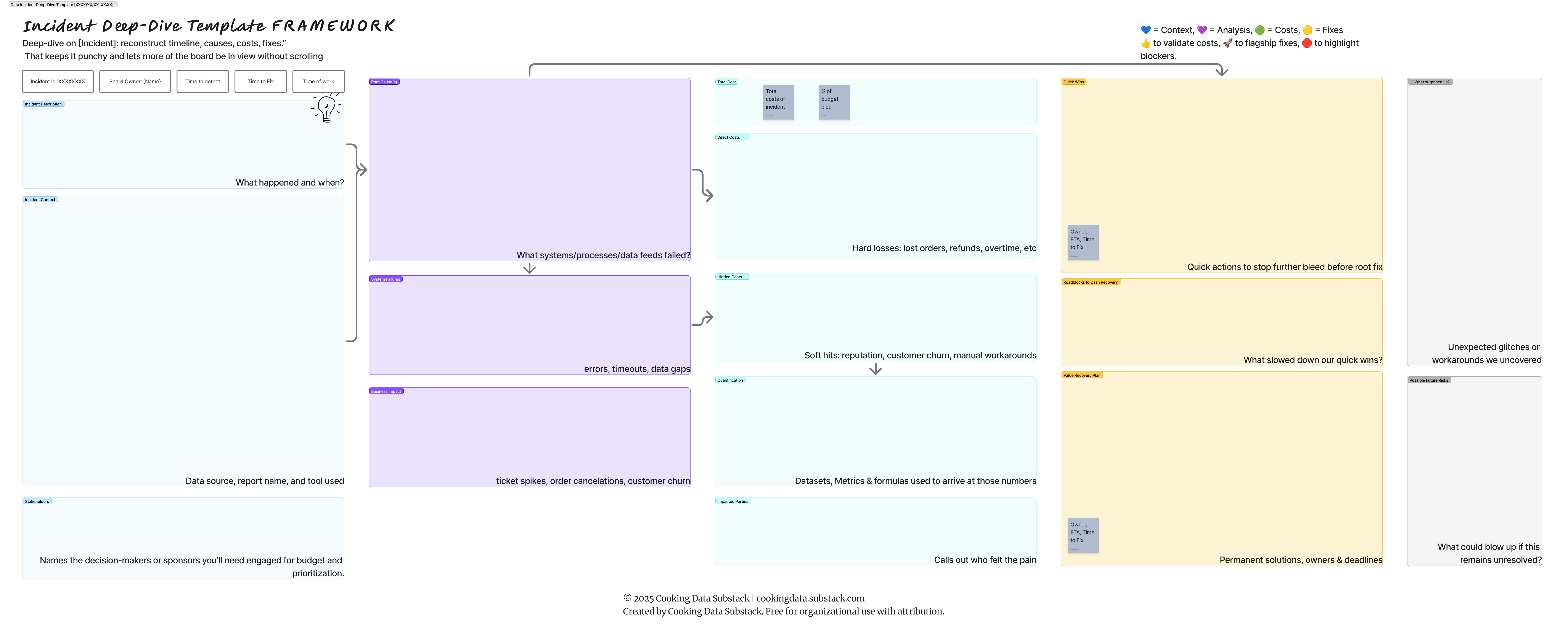
The Data Incident Deep‑Dive Template, is a lightweight, 1‑slide framework that combines Wabi‑Sabi’s embrace of imperfection with a laser focus on Data ROI. Think of it as a rapid, cost‑centric alternative to a lengthy post-mortem.
Why Most Incident Reviews Fail
Blame & Drama: Teams default to 2‑hour “postmortems” that feel like therapy sessions, slow and tangential.
Lost in Jargon: Technical deep dives bury the business impact under code stacks and timelines.
ROI Unknown: Without quantifying costs, execs won’t prioritize fixes, so incidents repeat.
On Black Friday, our ingestion pipeline overloaded under traffic. The dashboard fell silent; decisions stalled. Was it €10K in lost ad spend? €50K? We had no idea, and no fast way to find out.
Flash Panic Call: On a regular Tuesday, the marketing team raised a data incident, part of their dashboard was missing, and they couldn’t optimize Reddit ads. In 20 minutes, data engineers, analysts, marketing leads, the CFO, and CMO were in a meeting. We spent 2 hours debugging, only to discover in the post-mortem three weeks later that Reddit accounted for just 1.2% of the budget, hardly critical. The effort far outweighed the impact.
These stories highlight why we need a faster, cost‑focused approach.
Glossary
Data ROI: Financial return generated from data assets or operations
Wabi‑Sabi: Embracing imperfect, evolving processes and iterating to improve
Deep‑Dive: A structured workshop to investigate and act on an incident.
The Solution: 1‑Slide Deep‑Dive
Our template guides teams, Data leads, Ops, IT/Engineering, Finance, plus an exec sponsor, through a 30-minute, asynchronous + live session to:
Reconstruct: What happened, when, and where (tools, data sources).
Quantify: Direct & hidden costs, total cost call‑out, and formulas (e.g., orders×AOV).
Plan: Quick wins, value recovery, blockers & possible future risks.
Reflect: “What surprised us?” insight and next‑steps.
Wabi‑Sabi Alignment: We accept we can’t get perfect cost estimates—but iterating our understanding after each incident moves us closer to true Data ROI.
Keep reading with a 7-day free trial
Subscribe to Cooking Data guided by Lior to keep reading this post and get 7 days of free access to the full post archives.